

Data Analytics has been an increasing area of focus in most businesses over the last couple of decades. The analytic process grew increasingly complex, requiring highly skilled quantitative professionals to develop analytics using complex tools. Over the last several years, the technology has evolved to allow business users to perform quantitative analytics that provides excellent insights without the need for the level of quantitative training required as little as 5 – 10 years ago. Quantitative expertise is still needed to provide oversight and develop complex analytics. However, the new software tools have allowed a broader set of users to perform very insightful analytics quicker and more focused on specific business needs.
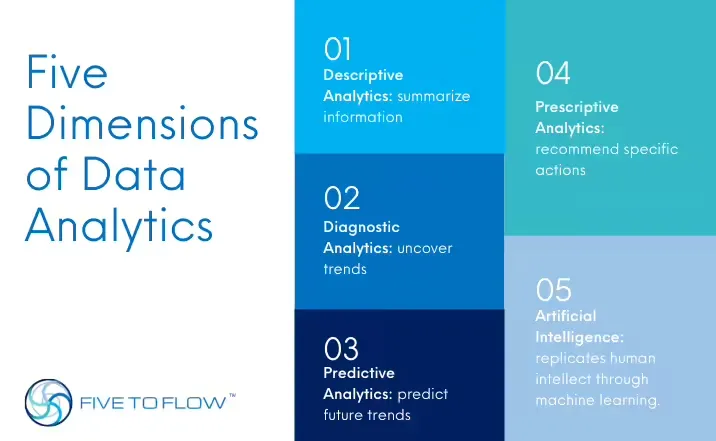
Predictive Analytics is the third step in the process. This leverages the results of the descriptive and diagnostic process to begin predicting future trends. It is important to have enough historical and real-time data to be relevant and useful. Here are some ways you can predict future trends.
Artificial Intelligence (AI) is the final step of the analytics process. The focus of this area has been to automate repetitive tasks to free up time and improve productivity (e.g. general ledger entries, including assigning approvals, performing additional entries, and creating payments). This step has been growing as the technology and methodology have evolved to improve ease of use and dramatic increase in the speed and ability to access very large datasets from various sources. This has tremendous capabilities, as we have seen in recent months, and also can add risk given the potential to add bias inadvertently.
For more information on how Five to Flow helps organizations accelerate change and growth, feel free to contact us. You can visit our Analytics Solutions learn more about our areas of expertise.