


Life isn’t so binary, however, and we are usually dealing with a mixture of extrinsic and intrinsic motivators. In this blog we are going to explore intrinsic motivation and why it’s important to harness for peak performance, a life filled with meaning, happiness, and flow.
Let’s take a moment and reflect on how it feels to be unmotivated. Are you energized? Are you creative? Are you engaged? Are you happy? I’m certainly not. Some personality types can bulldoze right past this lack of motivation and “grind” their way through life by sheer willpower, but is that the optimal way of doing things, or is that merely a workaround to a more fundamental problem? Spending a little time and energy upfront to establish what you’re interested in and how you’d like to affect the world around you will help define what you’re passionate about and how to spend your time purposefully. This will help lay the foundation to set meaningful goals that you are intrinsically motivated to achieve. Once that foundation is set and the goals are clear and filled with purpose, it’s a lot easier to find the energy, innovation, and focus to achieve them.
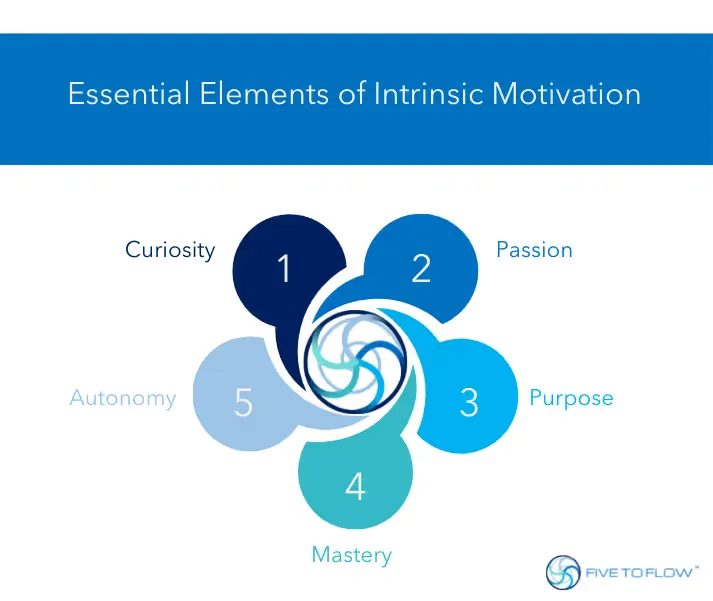
Dan Pink shares some studies that clearly show when it comes to mechanical skill-based work, like factory work or manual labor, incentives, and reward-based motivation drives better performance. But when it came to creative or cognitive-based work, incentives actually worsened performance. Extrinsic factors were useful at creating compliance, while intrinsic factors were far superior at creating engagement. He lists several flow triggers such as autonomy, mastery, and purpose as the keys to motivation. He suggests integrating them into our modern thought-based work environments to achieve better productivity as well as a healthier relationship with work-life balance. Obviously, people still need to get paid for their work, but we can see the benefit of being aware of how best to wield these variables.
The Flow Research Collective actually spells out their formula for intrinsic motivation similarly to Dan Pink, listing curiosity, passion, purpose, mastery, and autonomy as the main drivers. Essentially we need to feel purpose towards some meaningful goal, we need room for improvement (and a growth mindset to believe in that improvement), and we need the free time to pursue this goal. Curiosity plays a role by helping us find what we are interested in initially, while passions can arise from the intersection of multiple points of curiosity. Purpose, however, is developed by applying passion towards a societal or global scale issue. Essentially, how is your passion able to make the world or a community better off. Not only does that last step increase motivation dramatically, but it also increases your business opportunities as well.
The Japanese term Ikigai means “reason for being.” Ikigai in its most basic form is the intersection of what you love, what you’re good at, what the world needs, and what you can get paid for. When all those factors are aligned you’re likely living an actively engaged life that is full of intrinsic motivation and flow. You look forward to getting up in the morning out of excitement for what you can accomplish that day. Finding the drive and energy to perform hard tasks is almost effortless, and when you do eventually run into a bump in the road, your ability to handle adversity is much stronger. To me, this is an integral part of addressing the burnout and mental health crisis that has been happening since well before the pandemic. Feelings of purpose and productivity can have a huge impact on emotional health and self-esteem. Lack of motivation, lack of purpose, and lack of freedom (autonomy), however, have a more dampening effect on us mentally.
If this all sounds a little strange and fanciful, I don’t blame you. This is hardly how the current business world operates. If we want to incentivize, we immediately think of money, or maybe perks. This has obviously worked for decades so I’m not going to say it’s wrong. But we do have some tools at our disposal that we aren’t taking full advantage of, and that’s worth pointing out. There is also some supporting evidence for intrinsic motivation being as important, if not more so than money (once a baseline threshold has been met anyway). A study from MIT Sloan found that lateral career opportunities were 2.5 times more powerful as a predictor of a company’s relative retention rate compared with compensation, and lateral career opportunities were 12 times more predictive of employee retention than promotions. Lateral career shifts, in many cases, happen because that person is more interested intrinsically in the other role. Lateral moves based on more curiosity/interest will set that employee up with a better foundation for intrinsic motivation, leading to better productivity, more innovation, and thus better business outcomes for the company and more opportunities for the employee in the future. This is just one way to leverage some of these motivation triggers.
If you are interested in learning more about how Five to Flow can improve the five core elements of your organization, contact us today. For more information on flow concepts and how they improve business health, visit the Collective Voices blog for more articles.