
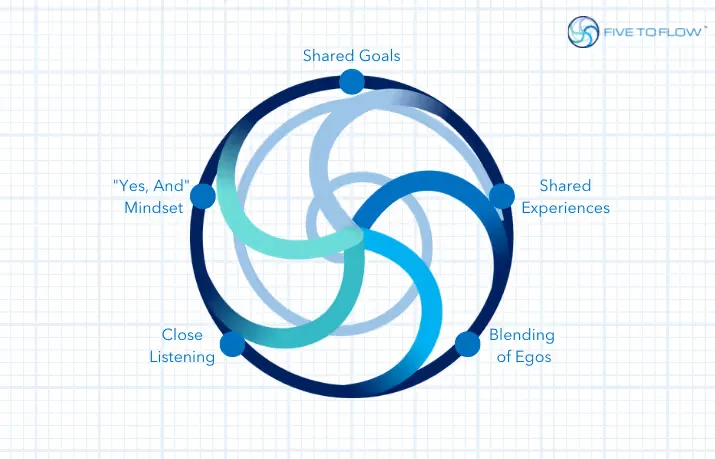
One of the group flow triggers that perfectly captures this concept is “blending of egos.” This is a kind of collective humility that allows a free flow of ideas regardless of rank or title. This leads to a greater pool of participation and more brain power that can contribute to the whole. More participation invites more sharing of unique ideas, risks, and opportunities that may otherwise have been unaccounted for.
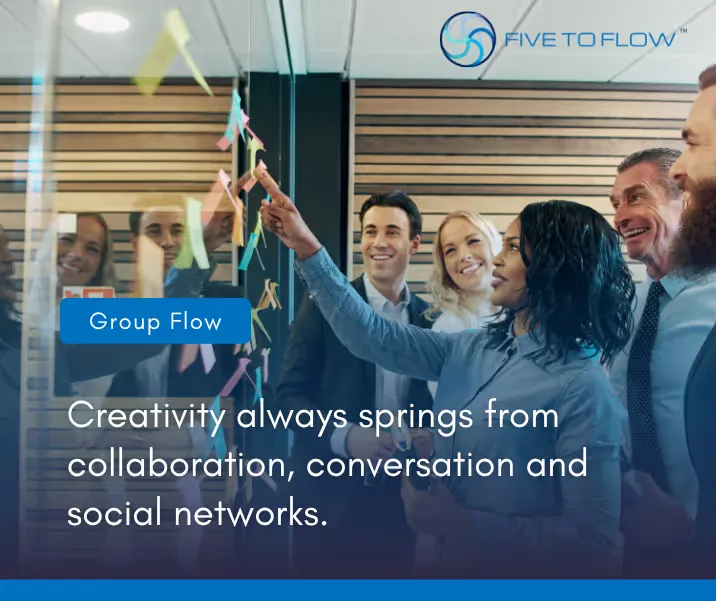
If we think about escape rooms, we can find many of the group flow triggers in action. Everyone is starting on an equal playing field; whatever hierarchy that existed before the activity is typically melted away once the game starts. There is a crystal clear goal that is challenging and provides a shared purpose for the group. With everyone on the same page, and while egos are blended, participation and pattern recognition can happen without fear of social repercussions. All input is welcome because no one has the answers yet. This makes escape rooms a fun and exhilarating experience for most people and is an incredible way to bond as a team or foster creative thinking.
Now that we have a general idea of what group flow is, what can we do to create an environment where it is likely to emerge? For starters, there needs to be dedicated time. The goal isn’t to create year-round group flow in the office; that’s unlikely to occur and will create a sense of failure when it doesn’t happen. Dedicated time could be a collaborative workshop over the course of one to three days. Strategic collaborative sessions that are free from the responsibilities of the day-to-day minutia and that have a purposeful goal to achieve are great opportunities to facilitate group flow. This can and should be fun. After all, how often do we get to step outside of our daily routine to really focus on where our business is going and how to make it more successful?
To maximize the potential for creative problem-solving, these collaborative sessions should have a cross-functional group filled with diverse perspectives, whether it be educational background, culture, experience level, or role at the company. Their knowledge base and skill sets should be complementary or of a similar level, but with room for a couple of wildcards who think outside of the box and challenge the group with an untainted point of view. The nuance to be mindful of is that diversity of thought makes group flow a much more potent tool, but the diversity of goals and purpose completely undermines the effectiveness of the team. Establishing a shared purpose and goal for the group is crucial for group flow, innovation, and building a sense of community.
Close listening. When ideas are getting tossed around in a group setting, it is imperative to understand them first before responding. Innovation and creative momentum are blocked when one or more people in the group have preconceived notions of how things should be done. When there is a shared goal, and an appropriate blending of egos, close listening is the next step to setting the stage for more group flow. This sounds easy enough, but all too often we are anticipating, rather than listening to understand. In a setting designed for group flow, concepts are changing, minds are open, and innovation is brewing.
Keep moving forward. After close listening, we want to encourage the momentum of the group. That happens with additive contributions, rather than combative. Build on what came before, even if you disagree. There will be time to disagree, reassess, and give critical feedback later. Right now, in the session, go with the flow and be open to where the group takes you. In order to reach an unexpected outcome, you may have to take an unexpected path to get there. Without doing this correctly, you risk circling back to doing things the way you’ve always done them, as all the innovation and problem solving gets stymied by aggressive feedback or fear of sharing an outlandish idea.
Familiarity. This one I can personally attest to as being very helpful for group flow. This is the idea of having a common language, a shared knowledge base or experience, and a communication style based on unspoken understanding. Having to slow down and go through a lengthy explanation kills momentum. Having the familiarity with your group to explain things shorthand or in novel ways that can be understood tacitly really ramps up the positivity and energy in the session. The excitement that someone else is on the same page as you – and can basically get to your next thought without you saying anything – can start a cascade of creativity and camaraderie.
This will be a challenge now more than ever with more and more work being done in virtual settings. And while there are ways to optimize the virtual experience, the value of meeting in person and creating shared experiences is irreplaceable as a way to build trust, communication, and familiarity with each other. Having a shared experience, even a negative one, can help bring a team closer together. Simply realizing that your colleagues feel the same way you do can create a greater sense of group empathy, bring a team together, and make it that much easier to share knowledge and solve problems down the road.
For individual flow, limiting distractions and having uninterrupted flow blocks are paramount. But for group flow, when interacting with others in rich environments how could you avoid distractions? The main source of distraction you have managed is your own thoughts. Thoughts that pull you out of the present moment can distract you from close listening and absorbing what’s going on around you, thus preventing you from participating to your full potential.
During a situation where group flow is the goal, egos have to take a back seat. The group is one entity and is working together towards a shared cause. When that prerequisite is met, the freedom to be creative and build on each other’s ideas can be accessed. By contrast, if a group is filled with individuals who are all walking on eggshells because they don’t know each other, don’t feel properly aligned with the goal, are worried about offending or being judged by each other, or are actively looking for ways to judge each other, then group flow will be non-existent.
If you are interested in learning more about how Five to Flow can improve the five core elements of your organization, contact us today. For more information on flow concepts and how they improve business health, visit the Collective Voices blog for more articles.