

The mantra “It’s OK not to be OK” became more mainstream during the pandemic. But what does it mean in a work environment, and how are leaders dealing with employees who are “struggling”? How are workplaces encouraging balance and well-being at work and at home? And, how are the employees helping themselves? To answer this, we must first ask, “What does it mean to be struggling, specifically at work?” In our context at Five to Flow, it means employees are stressed out with raised levels of cortisol and adrenaline, are constantly distracted, are experiencing a lack of control, and don’t know how to manage this condition for themselves or don’t feel as though the current work paradigm supports an ability to focus and access flow.

I want to challenge executives, leaders, shareholders, and board members to consider something. Not all contributors to employee disengagement have to do with attitude, skillset, resiliency, the age/generation of the worker, or the company culture. In fact, in my experience, it’s more about the barriers and obstacles put in an employee’s way so they actually can’t just focus and get sh*t done. Most employees desire jobs that challenge them and provide purpose in their lives. They want to contribute to the success of their team and the overall company. Individual and team achievements – as well as learning together from failure – is how they can make progress, innovate, and tap into creativity. It is how they can exit that feeling of struggling and move forward. Unfortunately, though, they are working in a world where:


It’s near month end and quarter end and you are close to making your quota after having worked very hard under a lot of pressure from your leadership team. You have an existing customer who contacts you – they want to simply add 30 new licenses within the next few days for a weekend go live that includes a new group. Amazing; you are going to make your number by the last day of the month! You quickly input the order in your CRM, assuming you can simply hit submit, process for invoicing, and easily have the new licenses provisioned in time for your customer. But no, this is not the case. The order has to go through your sales manager, order administration, and legal first. It makes the first two approvals, but legal declines it Friday morning stating it needs a special line item added even though this is a simple add-on to an existing contract. It’s Friday at 4:00 pm, you add the line, submit, and it goes through the process again, from the beginning. Your customer is calling, “Where are my new licenses?!” You can’t answer yet. Legal doesn’t get to it before 5:00 pm on Friday and has gone for the day. It’s now officially the weekend, you miss the quota deadline, and your formerly happy customer does not get what they need for their go live. They are furious and you are frustrated, feeling like you have no control over your own or your customers’ success. Once this similar situation happens multiple times, you become disenchanted and start to disengage, dreaming of a job where you can deliver value quickly without process and technology handcuffs that caused eight hours of extra work and rework for a small deal that pulled you from other valuable or more strategic customer interactions.
At a product and professional services company. What your company sells is complex and requires collaboration of multiple experts to create the perfect solution for the order, ensure all components are ready to be delivered during the install period, and relies on customers to be responsive and available when you have the team ready to conduct the deployment. Things run behind at the customer and they cancel at the last minute, causing your professional services team to go back on the bench until the customer is ready. When they are ready, the only staff you have available is new and not fully skilled on the solution being implemented, but you have to send him any way to get the work started. The new tech calls the Help Desk to support the install which consequently takes twice as long as it would have with the senior personnel. The customer complains to the new technician, who feels powerless in the situation, having been advised not to tell the customer he is new to the company. Meanwhile, your leadership team measures you on installs being on time and your team being utilized, but all of your planning is manual, there are no mechanisms in place to indicate delays out of your control, your technicians rarely receive the upskill training they need on new solutions so they can manage according to the forecasted timeline, and there is no automation to the scheduling to ensure you can get the right person in the right place at the right time. The Help Desk representative gets reprimanded for not taking enough calls because he was stuck with the new tech onsite. You are frustrated, the technician is frustrated, the Help Desk is frustrated and the whole team begins to disengage because they feel powerless to deliver value in this current model.
At Five to Flow, we have studied The Maslach Burnout Inventory (MBI), which is recognized as the leading measure of burnout and validated by 35+ years of extensive research. The most prevalent burnout triggers are:
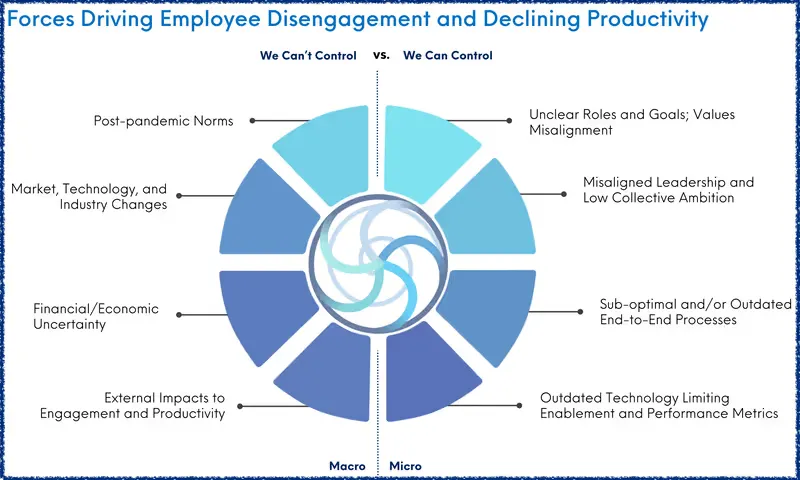
If you work for an organization that wants to promote flow, prevent burnout, and support employee engagement and satisfaction – which improves customer experience and increases productivity, and therefore, increases revenue and profitability – consider ways you can:
Seem like a tough list to achieve? Nah. These are the ways we helped the organizations in the vignettes above – some in a very short period of time by implementing some “quick wins” aligned with our Achieve Flow™ assessment outcomes.
As an individual, you have some steps you can take as well:
Fixing the root causes of these issues in your workplace is not fluff; employee engagement solutions get us all to where we want to be: happy, productive, earning money, and growing as an organization. If you want to know where you and your organization stand on overall health, take the Wellness Wave™ and book a discovery session.